
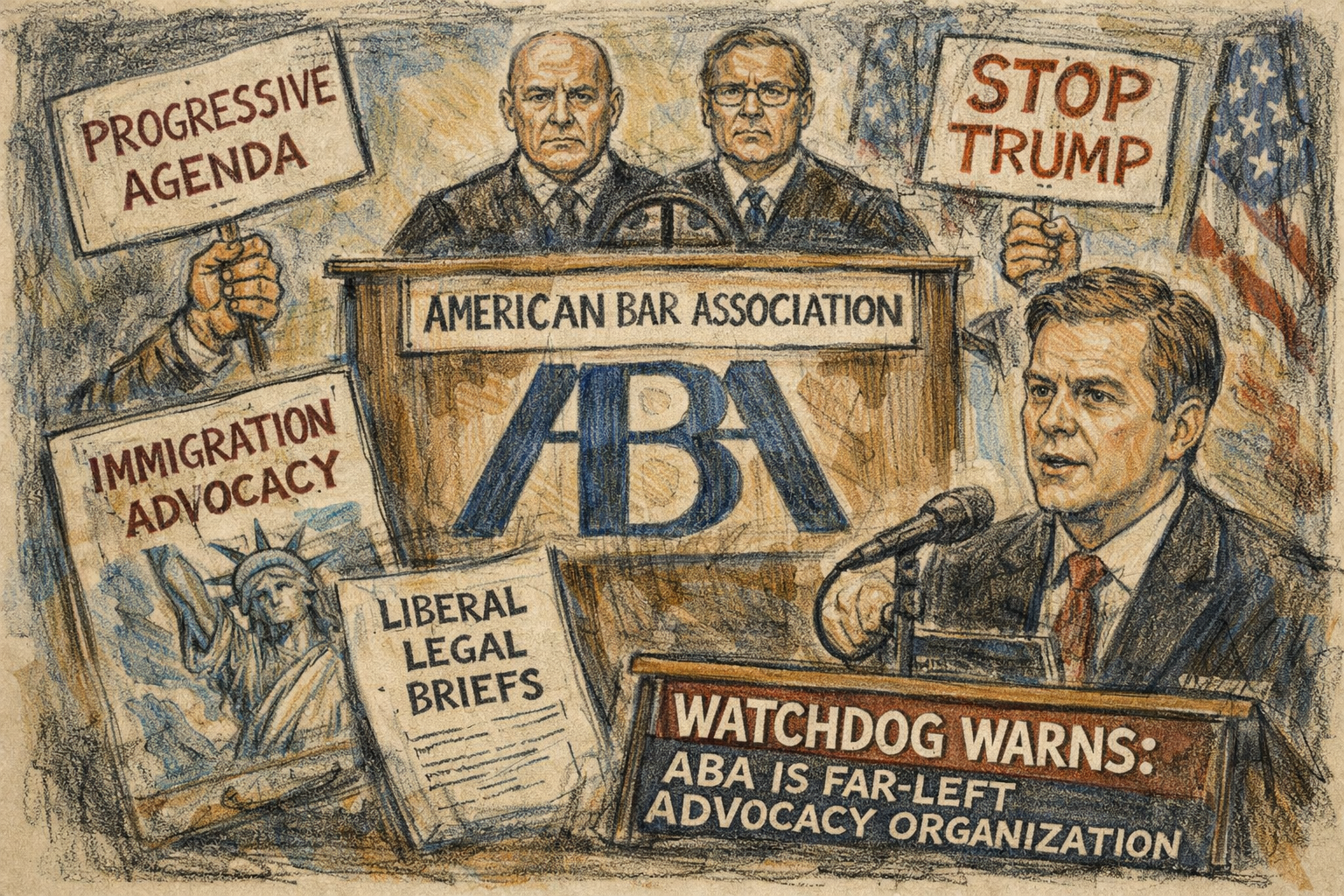
The legal establishment still expects the public to treat the American Bar Association like some elevated, nonpartisan referee of professional standards. That image becomes harder to sustain every year. A new review from America First Legal argues that the ABA’s amicus brief practice has drifted decisively into left-wing advocacy, and the basic charge is difficult to dismiss on its face. Fox News reported this week that AFL’s review found that more than four in five ABA briefs over the last decade pushed what it described as a progressive agenda, with America First Legal President Gene Hamilton saying immigration advocacy had become the program’s “dominant focus.” See Fox News’ report here.
If that assessment is even directionally correct, the problem is bigger than one disagreement over one case. The problem is institutional. The ABA still wants the prestige that comes from being treated as a serious professional body while repeatedly intervening in major legal disputes on one side of the ideological battlefield. At some point, the country is entitled to stop pretending that this is neutral stewardship of the law and start calling it what it looks like: organized progressive advocacy wearing a bar-association badge.
The Charge Is Not Just About Tone. It Is About Patterns.
According to Fox News, AFL’s report reviewed the ABA Standing Committee on Amicus Curiae Briefs over the last ten years and concluded that roughly 80 percent of its filings advanced left-leaning positions, while the rest were neutral or non-conservative rather than clearly supportive of conservative legal outcomes. Fox also reported that AFL argued the ABA had not filed a single brief in ten years, across two Trump administrations, that could fairly be described as supportive of a conservative legal position. See Fox News.
That accusation lands differently because the ABA’s own structure confirms how formal and deliberate the amicus process is. The ABA says its Standing Committee on Amicus Curiae Briefs reviews all proposed briefs to be filed in the name of the association and recommends whether they should be approved. In other words, these are not random one-off outbursts from rogue members. They are institutionally screened interventions that carry the ABA’s name. See the ABA’s own explanation of the process here.
The ABA Keeps Showing Up On The Same Side Of The Biggest Fights
The clearest reason the neutrality claim is collapsing is that the ABA keeps appearing in major national controversies on the same side of the political divide. Earlier this month, the ABA filed an amicus brief opposing the Trump administration’s birthright citizenship order and argued that the order would create legal chaos and undermine a foundational constitutional guarantee. The ABA’s own description of that filing is available here, and the brief itself is available from the Supreme Court docket here.
No serious observer thinks that is the only case that matters. It is simply the latest reminder that when the country reaches a major legal and political inflection point, the ABA’s institutional voice tends to emerge on the same side as the broader progressive legal establishment. That does not make every one of its arguments wrong. It does make the fiction of neutrality harder to maintain.
Even The Trump Administration Has Started Treating The ABA Like A Political Actor
The executive branch has already begun responding as if the ABA is not a neutral professional body. Fox’s report notes that in February 2025, Federal Trade Commission Chairman Andrew Ferguson announced a policy barring FTC political appointees from holding ABA leadership roles, participating in ABA events, or renewing ABA memberships. That move reflected a broader view inside the administration that the ABA had become politically compromised. See Fox News.
That shift matters because institutions lose their special standing gradually, then all at once. For years, the ABA benefited from a kind of automatic deference in media coverage, legal culture, and government relations. But once enough people conclude that the organization behaves like a conventional ideological interest group, they stop seeing any reason to keep extending those courtesies.
Immigration As A Dominant Focus Says A Lot
One of the most striking parts of the AFL critique is the claim that immigration advocacy has become the ABA amicus program’s dominant focus. Fox’s report quotes Gene Hamilton saying exactly that. If true, that tells the country something important about institutional priorities. The ABA is not spending its prestige mainly on narrow questions of legal ethics, attorney discipline, or technical questions of court administration. It is spending that prestige on some of the most contested policy fights in modern American politics. See Fox News.
That would be revealing even if the ABA openly called itself a progressive advocacy organization. But it does not. It still trades heavily on the aura of professional neutrality and institutional seriousness. That is exactly why the amicus pattern matters. The more often a supposedly neutral body intervenes on behalf of one ideological coalition, the less credible its neutrality becomes.
This Is Why Conservatives No Longer Trust The ABA
Conservative distrust of the ABA did not appear out of nowhere. It has been building for years across multiple fronts, including legal education, judicial politics, and public statements about the rule of law. The association’s amicus practice is just one more arena where that distrust has hardened. The problem is not merely that conservatives lose arguments. The problem is that the organization keeps presenting itself as a professional guardian of legal norms while taking positions that align, again and again, with progressive legal and political priorities.
Once that pattern becomes visible, conservatives are right to ask why the ABA should keep receiving special treatment from Republican administrations, conservative judges, or right-leaning lawyers. A progressive advocacy organization is entitled to advocate. It is not entitled to automatic deference while doing it.
What Should Happen Next
- Republican officials should stop treating the ABA like a neutral institution. If it wants to intervene like a political actor, it should be treated like one.
- Lawyers and judges should scrutinize ABA interventions on the merits, not on prestige. The organization’s name should not substitute for independent judgment.
- The public should stop confusing professional branding with neutrality. The ABA’s own amicus process is formal and deliberate, which makes repeated ideological alignment more significant, not less. See the ABA’s process description here.
- Conservatives should keep building alternative legal institutions. If the old gatekeepers have chosen sides, there is no reason to keep pretending they speak for the entire profession.
Conclusion
The ABA can file whatever briefs it wants. That is not the issue. The issue is whether the country should keep pretending those briefs come from some neutral mountaintop above politics. The warning from America First Legal is blunt, but the core point is hard to ignore: if more than four in five briefs are pushing a progressive agenda, and if immigration advocacy has become a dominant focus, then the ABA is no longer functioning like a detached legal institution in this arena. It is functioning like a political actor. See Fox News.
That means conservatives should stop treating the ABA like an impartial legal powerhouse and start treating it like what it increasingly appears to be: another well-funded, well-branded piece of the progressive advocacy machine.
Leave a Reply